
As the pace of business picks up, meeting customer expectations while delivering timely and accurate information can be a challenge. Semantic clustering, a patented machine learning technology offered by Inbenta, lets companies uncover content gaps and enrich their customer experience.
Here’s something obvious but worth repeating: Customers don’t like it when they can’t find something on your website.
In fact, 88% of internet users are less likely to return to a website after a poor user experience.
How do you know if your search has failed them? They may choose not to click on the provided information, they may leave the page entirely, or they may reach out for further assistance. These responses tell you that your site is missing crucial information — or that the information you have isn’t getting to the people who need it. You have a knowledge gap. Luckily, we know how to bridge it.
Semantic clustering
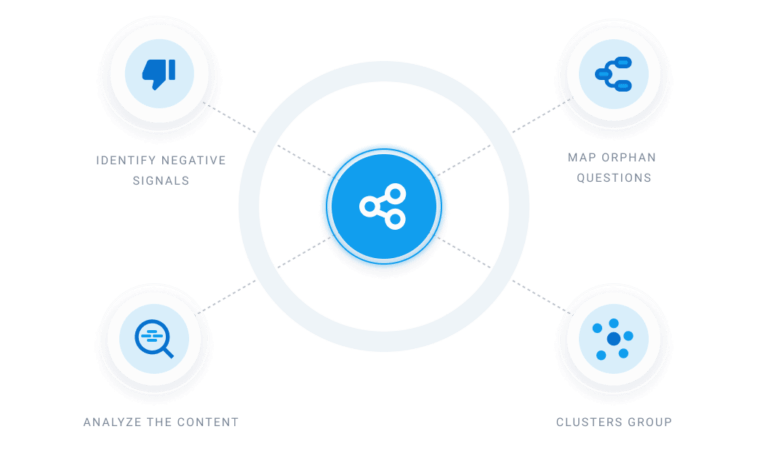
Inbenta's patented semantic clustering technology uses machine learning algorithms to map these negative signals, identifying clusters of similar inquiries to your website that don’t receive satisfactory responses. This data is a valuable resource, alerting your business to crucial new content you need to create if you want to answer your customers' most pressing questions.
So how does it work?
Identifying content gaps
Imagine finding a puzzle piece in the middle of the street, unsure what picture it’s a part of. That can be the challenge for a business running a website that needs to respond to customers’ various needs.
Semantic clustering helps your site locate and piece together similar unanswered queries, creating a complete picture that lets you fill knowledge gaps efficiently.

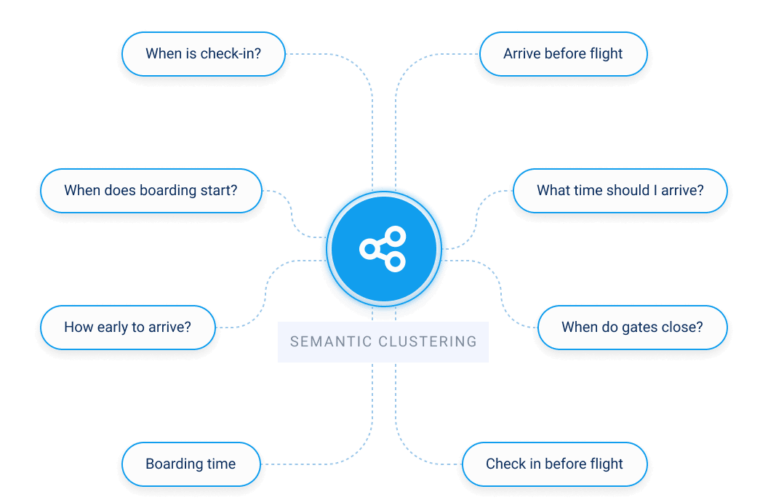
Use case: “When do the gates close?”
For instance, let’s say you’re an airline that receives an array of unanswered queries about when your boarding gates close. Customers may phrase their questions differently: "What time should I arrive?" or "When do the gates close?" Semantic clustering understands the intent of these questions and recognizes that they belong to the same group or cluster — essentially, when passengers should arrive at the airport for their flight.
If the answer is already on your site, it eliminates confusion and lets you deliver the answer consistently and accurately. If it isn’t, this knowledge gap analysis will quickly show you areas that need additional answers and information.
By addressing these gaps proactively, companies can ensure their customers find the information they need quickly and easily, without resorting to support tickets.
In brief:
- Customers not clicking on information, leaving your page, or seeking help indicates a search failure and knowledge gaps.
- Inbenta’s semantic clustering uses machine learning to identify clusters of similar, unanswered queries.
- Semantic clustering helps businesses efficiently fill content gaps by understanding customer query intent.
- This proactive approach ensures customers find information quickly, reducing support tickets.
Related Articles